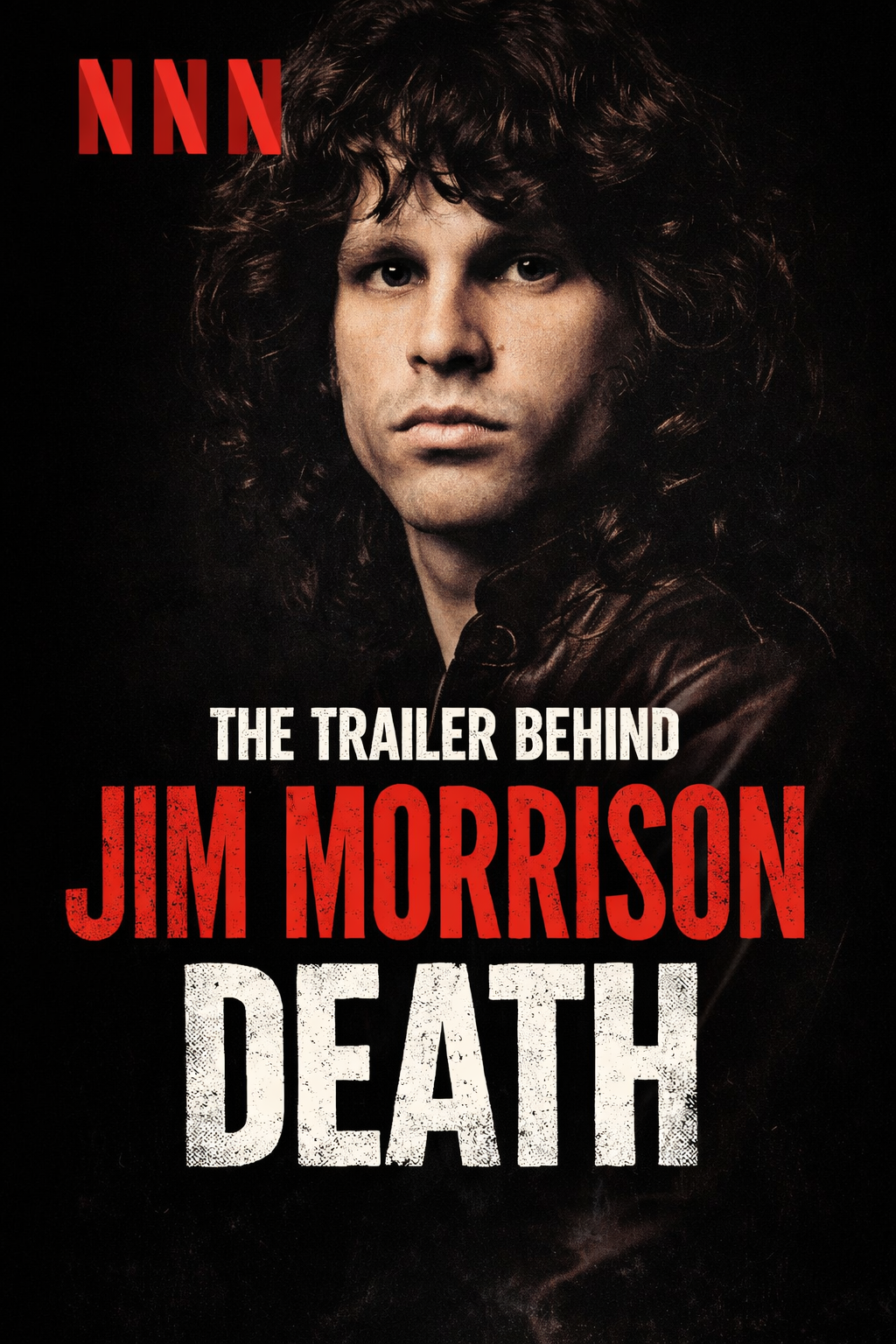
Netflix has quietly stirred global curiosity with the release of a haunting trailer that revisits one of rock music’s most enduring mysteries: the death of Jim Morrison. Rather than offering definitive answers, the preview sets a somber tone, inviting viewers into a layered exploration of myth, memory, and unanswered questions surrounding the legendary Doors frontman.
The trailer leans heavily into atmosphere, using shadow, archival textures, and slow-burning narration to reflect the uncertainty that has followed Morrison’s passing for decades. From the opening moments, it is clear that this project is less about sensationalism and more about revisiting history through a modern investigative lens.
Jim Morrison’s death in Paris in 1971 has long been surrounded by speculation. Officially ruled as heart failure, the absence of an autopsy and the secrecy of the circumstances fueled countless theories. The trailer acknowledges this ambiguity, presenting conflicting perspectives without immediately privileging one over another.
What stands out is the way the documentary appears to balance Morrison the icon with Morrison the human being. The trailer hints at intimate moments, personal writings, and reflections from those who knew him, suggesting a more nuanced portrait than the familiar image of the wild, self-destructive rock star.
Netflix’s approach seems deliberately restrained. Rather than promising shocking revelations outright, the trailer emphasizes process—archival research, interviews, and reconstructed timelines. This framing positions the project as an inquiry rather than a verdict, allowing viewers to engage critically with the material.
The use of sound is particularly striking. Snippets of The Doors’ music blend with ambient noise and silence, reinforcing the emotional weight of Morrison’s legacy. These choices suggest that the documentary will treat his art not as background, but as a key to understanding his mindset and the era he lived in.
The trailer also gestures toward the cultural context of the late 1960s and early 1970s, a period marked by excess, experimentation, and profound social change. Morrison’s life and death are presented as inseparable from that moment in history, shaped by fame, pressure, and shifting values.
Rather than portraying conspiracy as fact, the preview frames alternative theories as part of a broader conversation. This careful positioning may appeal to both longtime fans and skeptical viewers, offering space for interpretation without asserting certainty where none exists.
There is also an undercurrent of reflection on how legends are made. The trailer subtly questions whether the mystery itself has become part of Morrison’s immortality, raising the possibility that the unanswered questions have overshadowed the reality of his life and work.
By revisiting old evidence with new voices, the documentary appears to ask not only what happened, but why the world remains so invested in the question. The trailer suggests that Morrison’s death is as much about collective fascination as it is about historical fact.
As anticipation builds, the project positions itself as a contemplative examination rather than a scandal-driven exposé. Whether it ultimately changes perceptions or simply reframes the discussion, the trailer makes one thing clear: Jim Morrison’s story continues to resonate, unfinished and unresolved, more than half a century later.