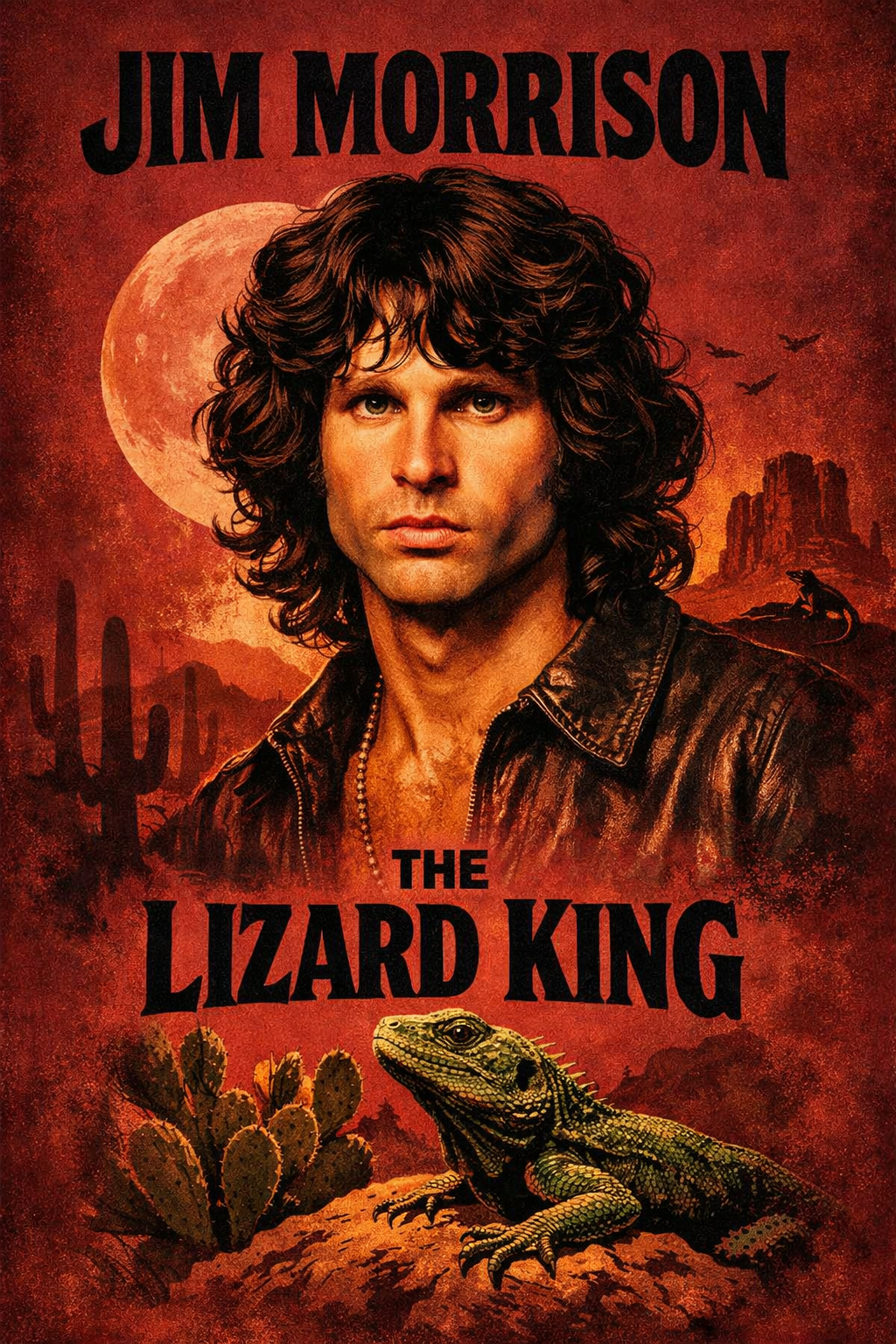
Jim Morrison’s nickname “the Lizard King” is one of the most enduring and mysterious titles in rock history, a phrase that captures both his poetic imagination and his untamed stage presence. Unlike many rock monikers that are assigned by the media or fans, this name was claimed by Morrison himself, emerging directly from his art, his performances, and his fascination with myth, ritual, and transformation. To understand why he embraced this identity, one must look beyond music and into the deeper layers of his psyche.
The origin of the Lizard King can be traced to Morrison’s spoken-word poetry, most notably his poem and performance “Celebration of the Lizard.” In it, he famously declares, “I am the Lizard King, I can do anything.” This was not a boast in the conventional sense, but a symbolic statement. Morrison saw the lizard as an ancient, primal creature, one that existed close to the earth and represented instinct, survival, and raw power. By naming himself the Lizard King, he was stepping into a mythic role rather than a celebrity one.
Morrison was deeply influenced by mythology, anthropology, and psychology, particularly the works of Nietzsche, Joseph Campbell, and Carl Jung. He believed that modern society had lost touch with its primal roots, and that art—especially music and poetry—could restore that connection. On stage, he sought to become a kind of shaman, guiding audiences into a shared trance. The Lizard King persona allowed him to transcend the role of a singer and become a symbolic figure of chaos, freedom, and transformation.
His performances with The Doors often felt more like rituals than concerts. Morrison moved unpredictably, improvised lyrics, shouted poetry, and challenged both the audience and authority figures. In this sense, the Lizard King was not just a character but a state of being. He embodied the idea of shedding one’s skin, much like a lizard, and being reborn through experience, excess, and confrontation with the unknown.
The madness associated with the Lizard King image was not entirely an act. Morrison struggled with alcohol, inner turmoil, and the pressures of fame. He deliberately pushed himself toward the edge, believing that true art required risk and total immersion. The Lizard King became a way for him to justify and mythologize this self-destruction, framing it as a necessary journey rather than a personal downfall.
There is also a darker interpretation of the Lizard King myth. Some see it as Morrison wrestling with his own demons, using symbolism to mask vulnerability and fear. The more he leaned into the persona, the more difficult it became to separate the man from the myth. By the later years of his life, the Lizard King identity seemed to consume him, blurring the line between performance and reality.
Despite the chaos, the Lizard King remains a powerful symbol of artistic freedom. Morrison refused to be neatly defined by genre, expectation, or public image. He wanted to live and create without limits, and the Lizard King represented that ultimate rebellion. It was a rejection of order, conformity, and restraint in favor of instinct and raw emotion.
The nickname also reflects Morrison’s connection to the desert and the American Southwest, landscapes that appear frequently in his imagery and lyrics. Lizards thrive in harsh, sun-scorched environments, adapting to survive where others cannot. Morrison saw himself in this resilience, an outsider figure existing on the margins, observing society from a raw and unforgiving place.
Decades after his death, the Lizard King continues to influence musicians, poets, and artists. The phrase has become shorthand for a certain kind of fearless creativity, where art is lived rather than performed. Morrison’s myth endures not because of his excess alone, but because he dared to turn his life into a form of living poetry.
Ultimately, Jim Morrison was called the Lizard King because he chose to become one. It was a self-created myth that reflected his beliefs, his struggles, and his vision of what an artist could be. In embracing the Lizard King, Morrison transformed himself into a symbol—one that still crawls through the imagination of rock culture, shedding its skin but never truly disappearing.